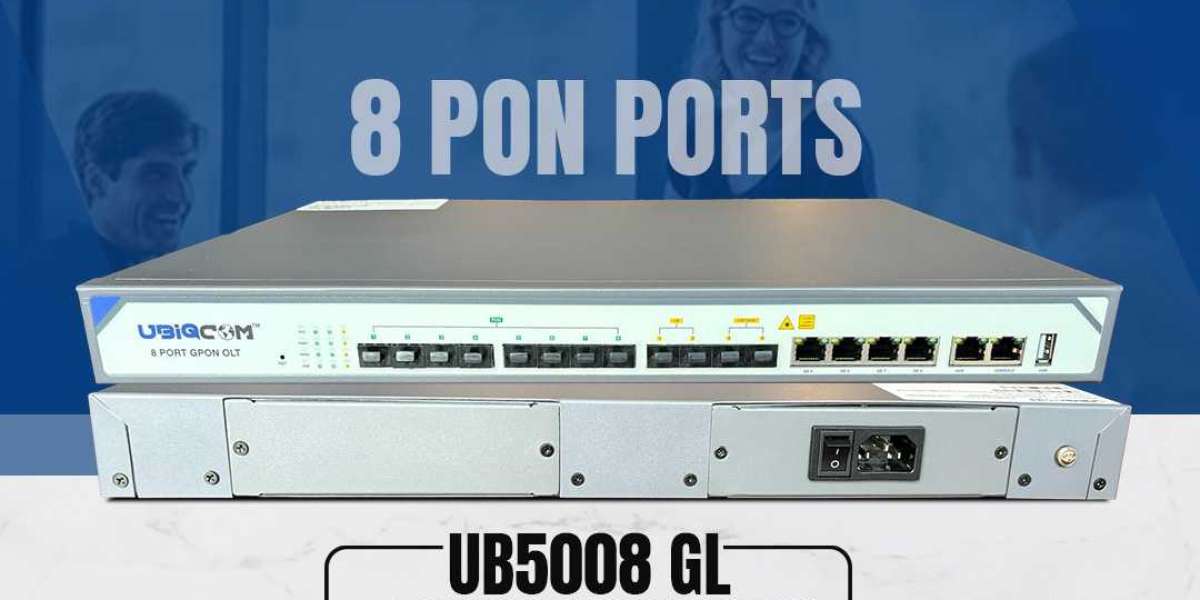

As the demand for high-speed internet continues to grow, service providers are increasingly turning to fiber-based technologies to deliver faster and more reliable connectivity. Among the key technologies enabling this transformation is the GPON OLT (Gigabit Passive Optical Network Optical Line Terminal). It serves as the central component in fiber access networks, allowing Internet Service Providers (ISPs) to efficiently distribute bandwidth to multiple users while maintaining high performance and stability.
From residential broadband and enterprise connectivity to smart cities and telecom infrastructure, GPON technology plays a crucial role in building scalable and future-ready networks. Understanding how a GPON OLT works and why it is essential for modern fiber deployments can help service providers and network engineers optimize their infrastructure.
What is GPON OLT?
A GPON OLT is a central device located at the service provider’s central office or data center that manages communication between the core network and multiple Optical Network Units (ONUs) or Optical Network Terminals (ONTs) at the user end.
It acts as the main control point in a GPON network and performs several critical functions:
Transmitting data from the service provider’s network to multiple end users
Managing bandwidth allocation across connected ONUs
Controlling network security and authentication
Ensuring stable communication over the passive optical network
Through a single fiber connection, a GPON OLT can serve dozens or even hundreds of subscribers, making it a highly efficient solution for broadband service delivery.
How GPON OLT Works in a Fiber Network
The GPON architecture follows a point-to-multipoint topology. This means that a single fiber link from the OLT is split into multiple fibers using passive optical splitters.
The basic workflow includes:
The OLT sends data signals downstream to multiple ONUs simultaneously.
Passive splitters distribute the signal to each connected user.
Each ONU receives the data intended for it and discards the rest.
Upstream traffic from users is sent back to the OLT using controlled time slots to avoid signal collisions.
This system allows service providers to maximize fiber utilization while maintaining high-speed connectivity.
Key Features of GPON OLT
A modern GPON OLT includes several features that make it suitable for large-scale fiber deployments.
High Bandwidth Capacity
GPON technology supports downstream speeds of up to 2.5 Gbps and upstream speeds of up to 1.25 Gbps. This bandwidth is shared among multiple users while maintaining consistent performance.
Scalable Architecture
Service providers can easily expand their network by adding additional GPON ports or modules. This scalability makes GPON ideal for growing broadband networks.
Efficient Bandwidth Management
GPON OLT devices use Dynamic Bandwidth Allocation (DBA) to efficiently distribute bandwidth based on real-time demand. This ensures optimal performance for every subscriber.
Reliable Network Management
Advanced management interfaces allow operators to monitor traffic, configure devices, and troubleshoot network issues from a centralized system.
Applications of GPON OLT
GPON OLT systems are widely used across multiple network environments due to their efficiency and scalability.
FTTH (Fiber to the Home)
GPON OLT enables service providers to deliver high-speed internet, IPTV, and VoIP services directly to residential users through fiber infrastructure.
Enterprise Connectivity
Businesses rely on fiber networks for high bandwidth and reliable communication. GPON OLT allows providers to support enterprise-grade connectivity with minimal latency.
Smart Cities and Public Infrastructure
Modern urban infrastructure depends on high-speed connectivity for surveillance systems, traffic management, and public Wi-Fi networks. GPON OLT plays a critical role in supporting these services.
Telecom and ISP Networks
Telecommunication operators and ISPs deploy GPON OLT equipment to efficiently manage large numbers of subscribers while maintaining high-quality service.
Benefits of Deploying GPON OLT
There are several reasons why service providers prefer GPON-based infrastructure.
Cost Efficiency
Passive optical networks eliminate the need for powered equipment in the distribution network, reducing maintenance and operational costs.
Long-Distance Coverage
Fiber networks powered by GPON technology can cover distances of up to 20 kilometers, making them ideal for both urban and rural connectivity.
High Reliability
Fiber networks are less susceptible to electromagnetic interference, ensuring stable and reliable communication.
Future-Proof Infrastructure
GPON networks provide a strong foundation for future upgrades and higher bandwidth technologies.
Why Dinstar is the Best GPON OLT Provider
When choosing equipment for fiber infrastructure, reliability and performance are critical. This is why many service providers trust Dinstar as the best GPON OLT provider for building robust fiber networks.
Dinstar solutions are designed to support large-scale FTTH deployments while maintaining high stability and efficient bandwidth management. Their GPON OLT systems are known for advanced management capabilities, flexible port configurations, and seamless integration with existing telecom infrastructure.
With a strong focus on innovation and quality, Dinstar equipment enables service providers to deploy fiber networks that are scalable, reliable, and ready for future expansion.
Conclusion
As global demand for high-speed internet continues to rise, fiber technologies like GPON OLT are becoming essential for modern broadband infrastructure. By enabling efficient bandwidth distribution, long-distance connectivity, and scalable network expansion, GPON OLT systems form the backbone of next-generation fiber networks.