
Introduction
Expanding into the Indian market offers significant opportunities for foreign manufacturers, but many products must comply with the regulations of the Bureau of Indian Standards (BIS). One of the most important certification programs for overseas manufacturers is the BIS FMCS. The BIS FMCS Scheme allows foreign manufacturers to obtain a license for products that are covered under mandatory Indian Standards before exporting them to India. Obtaining a BIS FMCS Certificate demonstrates that your products meet India's quality, safety, and performance requirements. Whether you manufacture electrical equipment, steel products, chemicals, cement, or consumer goods, BIS FMCS Certification helps ensure legal compliance and builds trust with Indian buyers.
What is BIS FMCS?
BIS FMCS stands for Foreign Manufacturers Certification Scheme. It is a certification program operated by the Bureau of Indian Standards (BIS) that enables manufacturers located outside India to obtain a BIS license for products covered under mandatory Indian Standards. Under this scheme, foreign manufacturers can legally export and sell certified products in India after meeting all BIS requirements. The scheme ensures that imported products offer the same level of safety and quality as products manufactured within India.
What is the BIS FMCS Scheme?
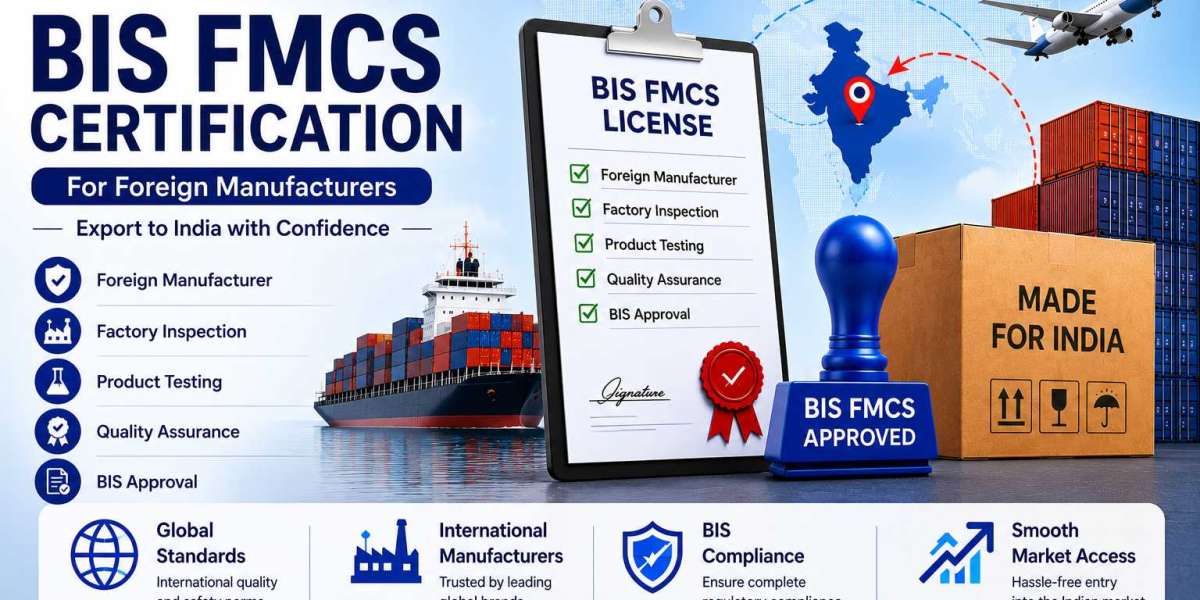
The BIS FMCS Scheme was introduced to regulate imported products and ensure they comply with Indian quality standards. Under this scheme, foreign manufacturing facilities are assessed by BIS officials before a license is granted. The assessment generally includes:
- Product testing
- Factory inspection
- Quality management review
- Manufacturing process verification
- Documentation verification
Once all requirements are successfully completed, BIS issues the certification license.
Who Needs BIS FMCS Certification?
BIS FMCS Certification is generally required for foreign manufacturers whose products fall under mandatory BIS certification.
Examples include manufacturers of:
- Electrical appliances
- Industrial machinery
- Steel products
- Cement
- Chemicals
- Household products
- Automotive components
- Construction materials
- Consumer goods
- Industrial equipment
If a notified product is exported to India, FMCS certification may be mandatory before it can be sold in the Indian market.
Importance of BIS FMCS Certificate
Obtaining a BIS FMCS Certificate offers several advantages for international manufacturers.
Legal Market Entry
Products requiring mandatory certification cannot legally enter the Indian market without BIS approval.
Customer Confidence
Indian consumers and distributors prefer certified products that meet recognized quality standards.
Business Growth
Certification makes it easier to expand into one of the world's fastest-growing markets.
Competitive Advantage
Certified products stand out against non-certified alternatives.
Quality Assurance
The certification process confirms that products consistently comply with Indian Standards.
Eligibility for BIS FMCS
Foreign manufacturers are generally eligible if they:
- Operate a manufacturing facility outside India.
- Manufacture products covered under mandatory BIS standards.
- Maintain adequate quality control systems.
- Meet applicable Indian Standard (IS) requirements.
- Appoint an Authorized Indian Representative (AIR).
The AIR acts as the official contact between BIS and the foreign manufacturer.
Documents Required for BIS FMCS Certification
The documentation requirements vary depending on the product, but commonly include:
- Company registration certificate
- Factory license
- Manufacturing process details
- Product specifications
- Product drawings
- Quality control documents
- Test reports
- Factory layout
- List of manufacturing equipment
- Calibration records
- Authorized Indian Representative (AIR) authorization
- Trademark authorization (if applicable)
Accurate documentation helps speed up the approval process.
Step-by-Step BIS FMCS Certification Process
The BIS FMCS Certification process generally includes the following stages.
Step 1: Identify the Applicable Indian Standard
Determine which Indian Standard (IS) applies to your product.
Step 2: Prepare Documentation
Collect all technical and legal documents required for certification.
Step 3: Product Testing
Products are tested according to applicable Indian Standards at recognized laboratories.
Step 4: Submit Application
The manufacturer submits the application along with supporting documents.
Step 5: Factory Inspection
BIS officials visit the overseas manufacturing facility to assess:
- Manufacturing process
- Quality control system
- Testing facilities
- Production capability
- Product consistency
Step 6: Compliance Review
BIS reviews inspection findings, laboratory reports, and submitted documents.
Step 7: Issue of BIS FMCS Certificate
After successful verification, BIS grants the certification license allowing products to be sold in India.
Common Challenges in BIS FMCS Certification
Foreign manufacturers often face several challenges during certification.
Common issues include:
- Incorrect product classification
- Missing documents
- Delays in laboratory testing
- Factory inspection scheduling
- Quality management deficiencies
- Communication delays
- Incomplete application forms
Proper preparation significantly reduces approval delays.
Benefits of BIS FMCS Scheme
The BIS FMCS Scheme provides several long-term business advantages.
Access to the Indian Market
Certified manufacturers can legally export products requiring mandatory BIS approval.
Improved Brand Reputation
Certification demonstrates commitment to quality and compliance.
Customer Trust
Indian buyers have greater confidence in certified products.
Regulatory Compliance
The certification helps businesses comply with Indian government regulations.
Business Expansion
Certification supports long-term growth in India's expanding industrial and consumer markets.
How Long Does BIS FMCS Certification Take?
The timeline depends on factors such as:
- Product category
- Testing requirements
- Factory inspection schedule
- Documentation quality
- BIS review process
Applications with complete documentation and compliant manufacturing systems are generally processed more efficiently.
Tips for Faster BIS FMCS Approval
To improve the chances of smooth approval:
- Select the correct Indian Standard.
- Prepare complete technical documentation.
- Maintain effective quality management systems.
- Test products through recognized laboratories.
- Keep production records updated.
- Respond quickly to BIS communications.
- Ensure manufacturing processes comply with Indian Standards.
Following these best practices helps reduce delays and avoids unnecessary rework.
Conclusion
The BIS FMCS is an essential certification program for foreign manufacturers planning to supply products to India. The BIS FMCS Scheme ensures that imported goods meet Indian safety and quality requirements, while a BIS FMCS Certificate enhances credibility and enables legal market access. By obtaining BIS FMCS Certification, overseas manufacturers can expand confidently into the Indian market, strengthen customer trust, and maintain compliance with BIS regulations.